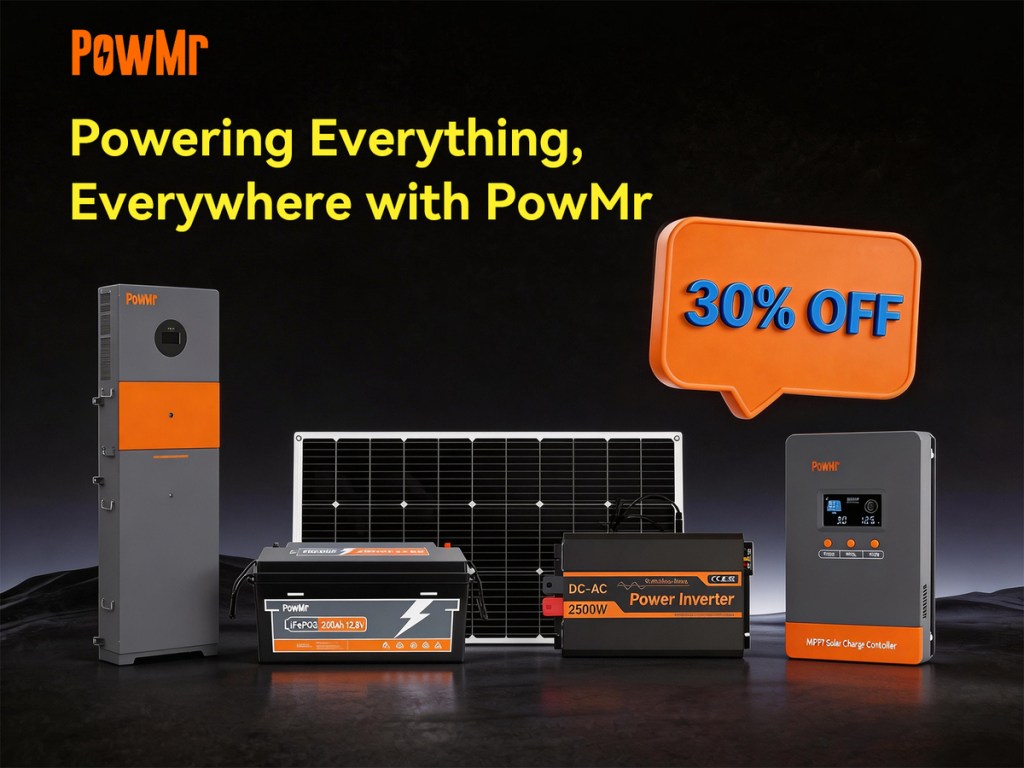
Designing an off grid solar system isn’t about picking a kit off a shelf — it’s an engineering exercise that starts with your energy habits and ends with a system built precisely for your climate, your loads, and your definition of independence. Get the math wrong, and you’ll either overspend by thousands or find yourself sitting in the dark during a February cold snap. Get it right, and you’ll have a power plant on your roof that runs for decades.
At PowMr Community, we’ve put together this step-by-step planning guide to walk you through every decision — from your initial energy audit to selecting the right panels, batteries, charge controller, and inverter. Whether you’re building a homestead in Alberta, a hurricane-resilient home in Florida, or a rural property in northeastern Brazil, the process follows the same engineering logic. The variables just change.
What Is an Off Grid Solar System and Who Needs One
An off grid solar system generates and stores all of your electricity independently — no utility connection, no net metering, no safety net from the grid. It consists of solar panels, a battery bank, a charge controller, and an inverter working together as a self-contained power plant. Unlike grid-tied systems that export surplus energy and import it back later, an off grid solar system must produce and store every watt-hour you consume.
Who actually needs one? The answer is more nuanced than “people who live in remote areas.” Three distinct groups are driving off-grid adoption:
Remote property owners — If running utility lines to your location costs $15,000–$50,000+ per mile, an off grid solar system often costs less than the grid connection itself, while eliminating monthly bills permanently.
Grid-resilience seekers — After hurricanes in Florida, ice storms in Texas, and extended outages in Quebec, a growing number of homeowners want a system that doesn’t depend on infrastructure they can’t control. Off-grid design principles apply even if you maintain a grid connection as backup.
Energy independence pursuers — Some homeowners simply want autonomy over their energy supply. With electricity costs rising and policy landscapes shifting — Roth Capital Partners projected a 33% year-over-year volume decline in U.S. residential solar for 2026 amid tax credit uncertainty — owning your entire energy infrastructure becomes an appealing hedge.
If you see yourself in any of these groups, the following steps will help you design a system matched to your real-world needs rather than a sales pitch.
Step 1: Conducting Your Energy Audit and Load Calculation
Your energy audit is the foundation of every component decision that follows. Skip this step or estimate loosely, and every downstream calculation — panel count, battery capacity, inverter sizing — inherits that error. The goal is a single number: your average daily energy consumption in kilowatt-hours (kWh).
How to Calculate Your Daily Energy Use
If you’re currently on the grid, pull your last 12 months of electricity bills. Add up the total kWh consumed, divide by 365, and you have your daily average. For a typical North American home, that’s somewhere between 20 and 35 kWh/day. A two-person household using efficient appliances might sit around 15–20 kWh/day, while a family of four with electric heating could push past 40 kWh/day.
If you’re building new or don’t have bill history, create a load table. List every appliance and device, its wattage, and how many hours per day it runs. Multiply watts × hours to get watt-hours, then sum everything:
Example load calculation for a modest off-grid home:
LED lighting (10 bulbs × 10W × 5 hours) = 500 Wh
Refrigerator (150W average × 24 hours) = 3,600 Wh
Laptop and router (100W × 8 hours) = 800 Wh
Well pump (750W × 2 hours) = 1,500 Wh
Washing machine (500W × 1 hour) = 500 Wh
Miscellaneous (phone charging, fans, etc.) = 600 Wh
Total: 7,500 Wh/day = 7.5 kWh/day
Account for Seasonal Variation
Don’t just calculate your summer load. In Canadian winters, you may run a blower for a wood stove, more indoor lighting, and perhaps a small electric heater for pipes. In Brazilian summers, air conditioning can double your daily draw. Build two load profiles — peak season and low season — and design your off grid solar system around the higher number.
Key takeaway: Add a 20–25% safety margin to your calculated daily load. This accounts for system inefficiencies (inverter losses, wiring losses, battery round-trip efficiency) and unexpected consumption spikes. If your load table says 7.5 kWh/day, design for 9–9.5 kWh/day.
Step 2: Sizing Your Solar Panel Array for Your Location

Once you know your daily energy requirement, the solar array size depends on one critical variable: how many peak sun hours (PSH) your location receives. A peak sun hour equals one hour of solar irradiance at 1,000 W/m² — the standard test condition for solar panels. More PSH means fewer panels needed; fewer PSH means you need a larger array to meet the same demand.
Peak Sun Hours by Region
Peak sun hours vary dramatically by geography and season. The U.S. Southwest averages 6–7 PSH annually, while the Midwest sits around 4–5 PSH. Canadian prairie provinces like Alberta produce roughly 1,276 kWh per kW per year (about 3.5 PSH annually averaged), while Quebec drops to approximately 1,183 kWh/kW/year. Brazil enjoys some of the world’s highest insolation, with its Northeast and Midwest regions receiving annual averages between 5.0 and 6.2 kWh/m²/day — essentially 5–6+ peak sun hours daily.
The Array Sizing Formula
Here’s the math, shown step by step:
Required array size (kW) = Daily energy need (kWh) ÷ Peak sun hours (PSH) ÷ System efficiency factor
The system efficiency factor accounts for real-world losses — dust, temperature derating, wiring, and inverter conversion. A conservative factor is 0.75–0.80.
Example: A home consuming 9.5 kWh/day in Austin, Texas (5.5 PSH) with a 0.78 efficiency factor:
9.5 ÷ 5.5 ÷ 0.78 = 2.21 kW array
Using 400W panels: 2,210W ÷ 400W = 6 panels (rounded up).
The same home in Edmonton, Alberta (3.0 PSH in winter design month):
9.5 ÷ 3.0 ÷ 0.78 = 4.06 kW, requiring 11 panels at 400W.
Critical note for off-grid design: Unlike grid-tied systems that size for annual averages, an off grid solar system should be sized for the worst month of the year — typically December or January in the Northern Hemisphere. If you size for annual averages, you’ll overproduce in summer and run deficits in winter, which defeats the purpose of grid independence.
Step 3: Designing Your Battery Bank — Capacity and Autonomy Days
Your battery bank is the single most expensive component and the one that makes or breaks an off grid solar system. Panels generate power; batteries are what let you use it at night, during storms, and on consecutive cloudy days. Two variables drive your battery sizing: daily energy consumption and autonomy days — how many days your system must operate with zero solar input.
Choosing Your Battery Chemistry
LiFePO4 (lithium iron phosphate) has become the dominant chemistry for off-grid applications, and the reasons are quantifiable. LiFePO4 batteries typically deliver 2,000–6,000+ charge cycles at 80% depth of discharge, compared to 500–1,500 cycles for lead-acid at only 50% usable depth of discharge. While LiFePO4 costs more upfront, the total cost of ownership over a 10–15 year lifespan is substantially lower.
Lead-acid still has a niche: extremely budget-constrained projects, very cold environments where batteries are stored in unheated spaces (LiFePO4 should not be charged below 0°C without a built-in heating function), or small backup-only systems. For a primary residence going off-grid, LiFePO4 is the engineering choice.
Battery Sizing Formula
Battery capacity (kWh) = Daily energy need × Autonomy days ÷ Maximum depth of discharge
Using our 9.5 kWh/day home with 2 days of autonomy and an 80% DoD limit on LiFePO4:
9.5 × 2 ÷ 0.80 = 23.75 kWh usable battery capacity
| Battery Type | Usable DoD | Cycle Life (at rated DoD) | Cost per kWh (Approx.) | Expected Lifespan | Maintenance |
|---|---|---|---|---|---|
| LiFePO4 | 80–90% | 2,000–6,000+ | $300–$500 | 10–15 years | None |
| AGM Lead-Acid | 50% | 500–1,200 | $150–$250 | 3–5 years | Minimal |
| Flooded Lead-Acid | 50% | 1,000–1,500 | $100–$200 | 5–8 years | Regular (water, equalization) |
How Many Autonomy Days Do You Need?
Autonomy days depend on your climate and risk tolerance. Two days is the minimum for LiFePO4 systems in sunny climates. In northern Canada or the Pacific Northwest, where consecutive cloudy days are common in winter, 3–5 days of autonomy is advisable — though this significantly increases battery costs. Many off-grid homeowners in these regions pair a smaller battery bank (2–3 days) with a backup generator to cover extended low-solar periods, reducing battery expense by 30–50%.
Decision point: If your location gets more than 4.5 PSH year-round (most of Brazil, U.S. Southwest), 2 days of autonomy with LiFePO4 is typically sufficient. If you’re below 3 PSH in winter (northern U.S., Canada), plan for 3+ days or include a generator backup.
Step 4: Choosing the Right Charge Controller — MPPT vs. PWM
The charge controller sits between your solar panels and battery bank, regulating voltage and current to prevent overcharging and optimize energy harvest. Think of it as a valve: it controls how energy flows from panels to batteries. The two technologies — MPPT and PWM — differ significantly in how they manage that flow, and the choice directly impacts how much of your solar production actually reaches your batteries.
PWM (Pulse Width Modulation)
PWM controllers are the simpler, more affordable option. They work by connecting the solar array directly to the battery and pulling the panel voltage down to match the battery voltage. This means any voltage produced by the panel above the battery voltage is essentially wasted. Typical PWM efficiency runs around 75–80%. PWM controllers require the solar array’s nominal voltage to match the battery bank voltage — a 12V panel for a 12V battery, for instance.
PWM makes sense when: You have a small system (under 400W), you’re in a consistently hot climate where panel voltages run lower anyway, or your budget is extremely tight.
MPPT (Maximum Power Point Tracking)
MPPT controllers use sophisticated electronics to continuously track the solar panel’s optimal voltage-current combination — its maximum power point — and convert the excess voltage into additional charging current. This decoupling of panel and battery voltage means you can wire higher-voltage panels (or panels in series) to charge a lower-voltage battery bank, with the controller handling the conversion. MPPT efficiency reaches 95–99%, and real-world gains over PWM typically range from 10–30%, depending on conditions.
According to Victron Energy’s technical documentation, MPPT will outperform PWM in cold to temperate climates, while both controllers show approximately the same performance in subtropical to tropical climates. That’s because cold temperatures increase panel voltage — exactly the surplus that MPPT converts into useful current.
For any off grid solar system larger than 400W, MPPT is the standard recommendation. The 10–30% efficiency gain pays for the higher controller cost within the first year of operation in most climates, and the design flexibility (series-wired panels, mismatched voltages) simplifies system expansion.
Sizing Your Charge Controller
For MPPT controllers, sizing is based on the solar array’s total wattage and maximum open-circuit voltage (Voc). Ensure the controller’s maximum input voltage exceeds your array’s Voc (accounting for cold-temperature voltage rise) and that its current rating matches or exceeds the array’s maximum power current (Imp). For a 2.4 kW array at 48V battery voltage, you’d need a controller rated for at least 50A (2,400W ÷ 48V = 50A).
Step 5: Selecting Your Inverter and System Architecture
The inverter converts DC power from your batteries into AC power for your household appliances. In an off grid solar system, it also sets the voltage and frequency reference for your entire electrical system — it is your grid. Selecting the wrong inverter doesn’t just reduce efficiency; it can prevent critical loads from starting or damage sensitive electronics.
Key Inverter Specifications
Continuous power rating (kW): This must exceed the total wattage of all loads running simultaneously. If your peak concurrent load is 3,000W, you want an inverter rated for at least 3,500–4,000W continuous.
Surge/peak power rating: Motors in well pumps, refrigerators, and air conditioners draw 2–6× their rated wattage at startup. A 750W well pump may demand 2,000W for 2–3 seconds. Your inverter must handle these surges without tripping. Off-grid inverters using heavy-duty transformers are specifically built for high inductive loads and surge demands.
Output waveform: Pure sine wave is non-negotiable for any off grid solar system powering a home. Modified sine wave inverters are cheaper but cause humming in motors, interference in electronics, and may damage sensitive devices. Every modern appliance expects clean sine wave power.
System Voltage: 12V, 24V, or 48V?
Your system voltage determines wire sizing, component compatibility, and overall efficiency. Here’s the decision framework:
12V: Small systems only (under 1 kW). High currents require thick, expensive cabling. Appropriate for cabins, RVs, and boats.
24V: Mid-range systems (1–3 kW). A reasonable balance of wire cost and component availability.
48V: The standard for whole-home off-grid systems (3 kW+). Lower currents mean thinner wires, reduced losses, and wider inverter selection. If you’re designing a serious residential off grid solar system, 48V is almost always the right answer.
Inverter-Charger Combinations
Many off-grid inverters include a built-in charger that can accept input from a generator or even a grid connection. These inverter-chargers simplify system design and allow you to run a backup generator that charges your batteries through the same unit that powers your loads. If you plan to include a generator in your off-grid design, an inverter-charger is the most practical approach.
Want to explore specific inverter and charge controller options for your system? Learn more from PowMr Community‘s product guides for detailed comparisons and sizing recommendations.
Climate-Adjusted Off-Grid Examples
Theory is useful; real numbers are better. Here are three worked examples showing how climate fundamentally changes the design of an off grid solar system, even when the daily load is identical.
Example 1: Alberta, Canada — 9.5 kWh/day Load
Design month PSH: ~2.5 (December)
Efficiency factor: 0.75 (cold temperatures boost panel voltage, but snow and short days reduce effective production)
Array size: 9.5 ÷ 2.5 ÷ 0.75 = 5.07 kW (13 × 400W panels)
Battery bank: 9.5 × 3 days autonomy ÷ 0.80 DoD = 35.6 kWh (LiFePO4 with heating function for sub-zero temperatures)
Charge controller: MPPT essential — cold temperatures push panel Voc high, and MPPT captures that excess voltage as current
Inverter: 5 kW pure sine wave, 48V system
Backup: Propane generator strongly recommended for December–February
Example 2: Central Texas, USA — 9.5 kWh/day Load
Design month PSH: ~4.0 (December)
Efficiency factor: 0.78
Array size: 9.5 ÷ 4.0 ÷ 0.78 = 3.04 kW (8 × 400W panels)
Battery bank: 9.5 × 2 days autonomy ÷ 0.80 DoD = 23.75 kWh (LiFePO4, standard temperature range)
Charge controller: MPPT recommended — significant temperature swings between seasons
Inverter: 5 kW pure sine wave, 48V system
Backup: Optional generator; two autonomy days covers most weather events
Example 3: Bahia, Northeastern Brazil — 9.5 kWh/day Load
Design month PSH: ~5.0 (lowest month, typically June–July)
Efficiency factor: 0.76 (high ambient temperatures reduce panel output slightly)
Array size: 9.5 ÷ 5.0 ÷ 0.76 = 2.5 kW (7 × 400W panels)
Battery bank: 9.5 × 2 days autonomy ÷ 0.85 DoD = 22.35 kWh (LiFePO4 can use 85% DoD safely in warm, stable temperatures)
Charge controller: MPPT still preferred, though the performance gap versus PWM narrows in consistently hot climates
Inverter: 5 kW pure sine wave, 48V system
Backup: Typically not needed in high-insolation regions
Notice the pattern: the same 9.5 kWh/day load requires nearly double the solar array in Alberta versus Bahia. Climate doesn’t just affect comfort — it dictates system cost.
Common Off-Grid Design Mistakes to Avoid
Most off-grid system failures don’t come from bad components — they come from bad planning. Here are the errors that cause the most headaches (and the most expensive fixes):
1. Sizing for annual averages instead of worst-month production. If you design your solar array around 5 PSH annual average but your worst month delivers 2.5 PSH, you’ll face chronic deficits exactly when you need power most. Always size your off grid solar system for the lowest-production month.
2. Undersizing the battery bank to save money. Forcing deep discharge cycles daily — say 90–100% DoD on LiFePO4 — dramatically shortens battery life. A battery bank that’s too small doesn’t just run out sooner; it wears out faster. Oversizing your battery bank slightly (targeting 50–60% daily DoD instead of 80%) can extend lifespan by years and reduce your long-term cost per stored kWh.
3. Ignoring surge loads when sizing the inverter. A 3 kW inverter will power 3,000W of steady loads just fine. But when your well pump, refrigerator compressor, and washing machine all kick on within the same minute, the combined surge can hit 6,000W+. Undersized inverters trip, overheat, or fail. Size for peak concurrent surge, not average load.
4. Using PWM controllers with high-voltage panels. Modern residential panels (60-cell or 72-cell) often produce voltages well above what PWM controllers can efficiently use with 12V or 24V batteries. Pairing a 40V panel with a 12V battery through a PWM controller wastes nearly half the available power. MPPT controllers convert that voltage difference into usable current.
5. Forgetting about wire sizing and voltage drop. Long cable runs between panels and batteries at low voltage (12V or 24V) create significant resistive losses. A 2% voltage drop on a 12V system represents much more lost energy than 2% on a 48V system. Higher system voltage and properly sized cables prevent this hidden efficiency drain.
6. No backup plan for extended low-solar periods. Even in sunny climates, weather anomalies happen. A week of overcast skies during the rainy season, a volcanic ash event, or unexpected snow accumulation can deplete your battery bank. A small propane or diesel generator sized to recharge your batteries provides insurance against the unpredictable.
Off-Grid vs. Grid-Tied: Is Off-Grid Right for You?
Not everyone who wants solar independence needs a fully off-grid system. Understanding the trade-offs helps you choose the architecture that matches your actual goals.
Grid-tied systems are simpler and cheaper because you don’t need batteries or a charge controller — you use the grid as your “battery.” But you lose power when the grid goes down (standard grid-tied inverters shut off during outages for safety), and changes to net metering policies can reduce the economic value of your exported energy. In California, for instance, the shift from 1:1 net metering to “Net Billing” structures has diminished the return on grid-exported solar power, which is driving a significant spike in battery attachment rates.
Hybrid systems combine grid connection with battery backup. You get the best of both worlds — battery power during outages, grid export when batteries are full — but at higher cost than a simple grid-tied system. This is the fastest-growing segment, particularly in storm-prone areas.
Off-grid systems deliver total independence but demand careful design. You need more panels (sized for worst-month production), a larger battery bank (for autonomy days), and possibly a backup generator. Total cost for a whole-home off grid solar system typically ranges from $25,000 to $70,000+ depending on system size and component choices.
Choose off-grid if: Your property is remote (grid connection cost exceeds system cost), you’ve experienced unacceptable outage frequency, you want zero dependence on utility policy changes, or your location has unstable grid infrastructure.
Choose grid-tied or hybrid if: You have reliable grid access, you want to minimize upfront cost, or local net metering policies still provide strong economic returns.
Frequently Asked Questions About Off Grid Solar Systems
Your Path to Energy Independence: Next Steps
Designing an off grid solar system is a sequence of engineering decisions, each building on the one before it. Start with your energy audit — that daily kWh number drives everything. Factor in your worst-month peak sun hours, not the annual average. Size your battery bank for realistic autonomy, not just for cost minimization. Select MPPT over PWM for any system above 400W. And choose a 48V architecture for any whole-home installation.
Every home is different. Your roof angle, your local climate, your specific appliance mix, and your tolerance for backup generation all change the math. The examples above give you a framework, but the details of your situation — a Canadian winter versus a Brazilian summer, a two-person cabin versus a four-bedroom homestead — will shape the final design.
If you’re ready to move from planning to component selection, explore our detailed guides on battery sizing, inverter comparisons, and charge controller selection. Have questions about your specific design? Our team at PowMr Community is here to help you work through the numbers.
You must be logged in to post a comment.