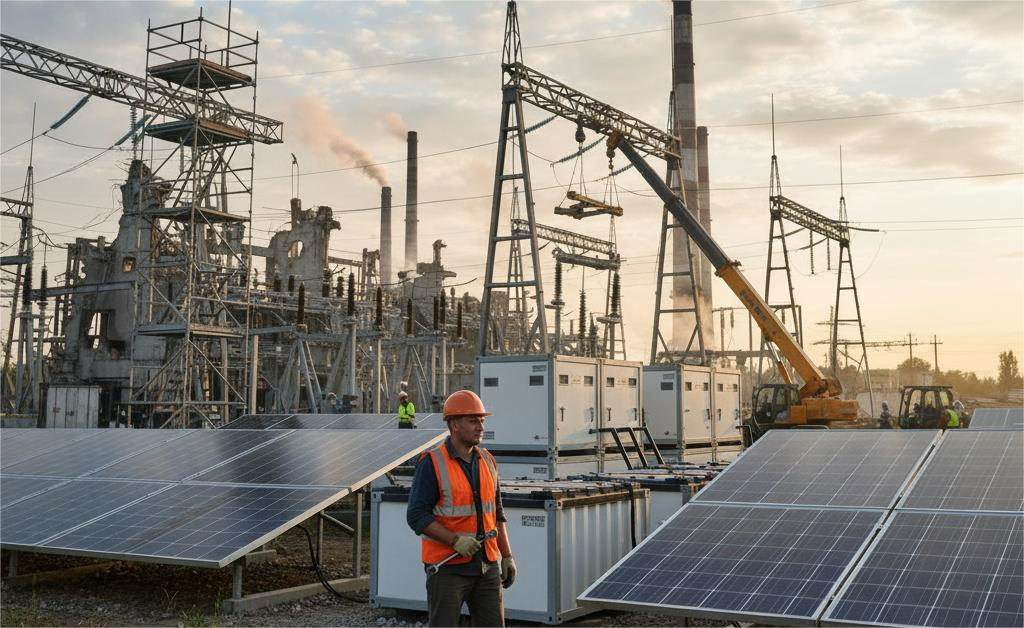
The sustained and targeted attacks on Ukraine’s energy infrastructure have driven the nation’s electricity system to the brink of collapse.
This deliberate strategy, which transitioned from focusing on transmission infrastructure in 2022 to attacking conventional power plants, aims to deprive the Ukrainian population and economy of essential energy. The resulting energy catastrophe necessitates urgent, comprehensive technical and structural interventions to mitigate severe, widespread power shortages, especially ahead of the critical winter period.
The primary reference for this paper is the case study Mitigating Ukraine’s Looming Electricity Crisis, authored by Georg Zachmann, Frank Meissner, and Iegor Riepin, which models and analyzes Ukraine’s electricity deficit.
The Scale and Impact of the Energy Catastrophe
The scale of the destruction is profound, with Ukraine having lost approximately 70% of its pre-war operating power generation capacity. This loss is divided between capacity that has been partially or completely destroyed (roughly 35%) and capacity located in occupied territories (the remaining 35%). The damage has placed immense strain on the grid, leading to devastating socio-economic, health, and ecological consequences. Since spring 2024, the large electricity supply deficit has necessitated scheduled rolling blackouts.
The situation is projected to dramatically worsen over the coming months, particularly as electricity demand rises during winter while generation from solar and hydropower simultaneously declines. Model projections for the period between June 2024 and May 2025 paint a stark picture of necessary curtailment (load shedding):
1. Near-Constant Shortages: Load shedding, defined as the curtailment of demand, will be required for 7,900 of the 8,760 hours in the year, equating to 90% of the time. This means virtually every Ukrainian electricity consumer will face power outages lasting several hours almost every day over the next 12 months.

2. Peak Deficits: At peak times, shortfalls are expected to reach up to 6,500 MW, which represents about one-third of the expected national peak load. For more than 1,000 hours, deficits will exceed 4,000 MW.
3. Unmet Demand: Despite electricity demand already having fallen by a fifth compared to the pre-war period—due to reduced economic activity and occupied territories—current conditions still imply that 20% of the remaining demand cannot be met in the coming months.
These significant power cuts are comparable to those typically seen in developing countries or in the aftermath of natural disasters. Such prolonged cuts cause significant harm to households, companies, and public services. For instance, energy shortages have well-documented negative consequences for enterprises and crucial impacts on health and healthcare services.
Pathways to Crisis Mitigation
While the situation is dramatic, technical solutions are available to address the crisis; however, their effective and rapid implementation requires substantial resources and a high degree of coordination.
Below is a clarification of these technical solutions, broken down by the roles and responsibilities of key stakeholders, including the government, the grid operator, municipalities and private actors.
Citizens and Communities: Local Adaptation and Preparedness
At the household and community level, Ukrainians are already adapting to a new normal—frequent outages, uncertainty, and increased self-reliance. While national efforts set the stage, individual and community actions can make a meaningful difference.
Household Preparedness
Residents are encouraged to invest in backup systems (UPS, generators, home-battery systems) to keep essential loads (lighting, communication, heating) operational during outages. Energy-efficiency is also vital: switching to LED lighting, reducing non-essential appliances, shifting heavy loads to more stable hours—these all lower grid stress. Installing rooftop solar + battery systems may not be possible for everyone, but where feasible they increase household resilience and reduce strain on the broader network.
Community Coordination
Neighbourhoods can organise to support vulnerable residents (elderly, medical-dependant, families with young children) during outages. Shared resources—community batteries, local generation, and shelters—can help. Transparent communication of blackout schedules and contingency plans can help residents plan their daily life more safely and calmly.
Grid Operator Perspective: Repair, Balance, and Resilience
From the perspective of the grid operator and distribution utilities, three themes dominate: maintaining operations under extreme stress; rapid repair; and enhancing future resilience.
Operational Stability
With generation capacity severely diminished, precise load-shedding, real-time balancing, rolling blackout and prioritisation of critical services become the norm rather than the exception. The operator must work closely with defence authorities to ensure access to damaged sites is possible, and that switching capabilities and redundancy are in place.
Rapid Repair and Reconstruction
Every repaired line or substation helps shorten blackout periods. However, rather than restoring large centralized plants, utilities are gradually turning toward modular substations, smaller generation units, and battery-based systems. As noted, DTEK restored much of its lost 90% generating capacity through millions of repair hours and an $83 million program, demonstrating resilience and rapid recovery of Ukraine’s energy infrastructure amid wartime damage.
Building Future Resilience
The long-term goal is to transition from a fragile centralized grid to a distributed, intelligent system. Interconnection with the European ENTSO-E network, energy-storage integration, and local generation all play critical roles.
DTEK and Fluence have launched Ukraine’s largest battery storage facility, delivering 200 MW power and 400 MWh capacity, boosting grid stability, enabling short-term energy supply, and supporting around 600,000 homes.
Government Response: Coordination, Resources, and Reform
In response to Ukraine’s ongoing energy crisis, the government plays a central role in both managing immediate shortages and preparing the electricity system for future resilience. While challenges remain significant, coordinated actions can help mitigate the impact on households, critical services, and the economy.
Immediate Coordination and Protection
Establish a central coordination mechanism to prioritize electricity for hospitals, heating, water systems, and critical infrastructure, while enhancing physical and cyber protection of power plants and substations.
Emergency Resource Management
Ensure adequate reserves of fuel, spare parts, and repair materials, and streamline logistics for rapid response to infrastructure damage to minimize outage durations.
Strategic System Reform
Develop a medium- and long-term roadmap for integrating decentralized energy sources, such as solar, wind, and storage, and update regulations and technical standards to support resilience, flexibility, and distributed generation.
Conclusion
In conclusion, Ukraine’s energy crisis underscores the devastating effects of targeted infrastructure attacks, leaving the country with chronic power shortages and severe socio-economic consequences. While immediate technical interventions, household preparedness, and rapid grid repairs are essential, long-term resilience depends on transitioning to a decentralized, intelligent energy system. Coordinated government action, community adaptation, and investment in storage and local generation are critical to mitigating outages and securing Ukraine’s energy future.
You must be logged in to post a comment.